In December 2025, CMS announced a landmark $50 billion award for Rural Health Transformation (RHT) grants, marking a five-year investment ($10 billion annually) into the 50 U.S. states. As of May 2026, every state has received its initial notice of award and is currently in the rapid implementation phase, moving from planning to the deployment of funds for clinical infrastructure.
This article explores how remote patient monitoring (RPM) infrastructure may help providers secure and implement rural health transformation grants by delivering measurable clinical outcomes, such as significant improvements among chronic care populations, as shown in recent research.
Current Status Rural Health Transformation Grants
Following the December 2025 announcement, states entered a “cooperative agreement” period with CMS to finalize budgets. Currently, individual states are establishing governance structures and issuing their own Requests for Applications (RFAs) to subaward these funds to local hospitals, FQHCs, and clinics.
Each state has a lead agency, which is often the State Office of Rural Health or the Department of Health manages the RHT distribution. Funding is split: 50% is distributed equally across all 50 states, while the remaining 50% is allocated based on rural population density and health facility needs. States must use at least 90% of their award for direct program initiatives; only 10% may be used for state administrative costs.
What is a State’s RFP Process for Rural Health Transformation Grant Programs?
While every state is participating, their internal processes vary. Some states have noted the following process.
- Nevada: Announced that its local Rural Health Innovation & Technology (RHIT) Grant RFP will be released in May 2026, with awards expected in September 2026.
- New Jersey: One of the earliest to move, with its first RFA for sub-grantees closing in January 2026.
- Arizona & South Carolina: Have prioritized the creation of telehealth hubs and the purchase of Remote Patient Monitoring (RPM) equipment in their initial spending plans.
- Oklahoma: Is focusing on hardware/software subsidies and technical support for rural providers to modernize their care delivery.
Rural Health Transformation Grants and RPM
Rural health transformation grants are specifically targeted at solving the core issues that plague rural medicine: limited connectivity, fragmented technology, and a lack of visibility between visits. By prioritizing RHT grants, CMS is fostering technology innovation that promotes efficiency and access to digital health tools.
Rural health transformation grants provide the necessary capital to implement remote care programs such as remote patient monitoring (RPM). RPM uses digital technology to collect and transmit clinical data, such as blood pressure, heart rate, and oxygen levels, directly to providers for review and early intervention.
Why RPM Is Sustainable
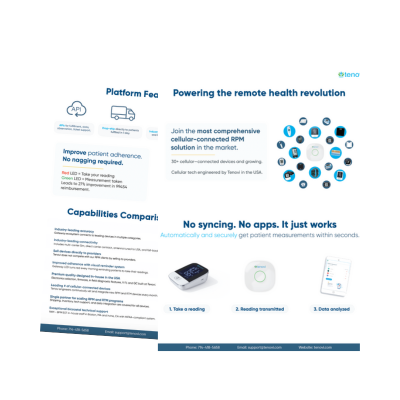
Rural health grants are most effective when used to build a unified, multi-condition infrastructure rather than isolated point solutions. Tenovi provides the specialized connectivity required by rural health transformation grants, featuring a universal cellular SIM that connects to the strongest available carriers without requiring apps, smartphones, or complex patient setup. This reliable, passive patient experience ensures high adherence and long-term engagement, directly aligning with the core priorities of RHT grants to create scalable and sustainable chronic care models.
Why Rural Health Transformation Grants Benefit from Tenovi Integration
Rural health transformation grants enable providers and health systems to integrate a continuous and proactive care model to expand healthcare beyond the walls of the clinic. Tenovi supports over 50 connected devices across various conditions through a single data stream, making it the ideal partner for providers seeking rural health transformation grants to manage multiple chronic diseases without siloed tools.
By utilizing rural health transformation grants to deploy Tenovi’s interoperable ecosystem, rural health systems can demonstrate measurable quality improvements, enhance equity through reliable rural access, and meet the high innovation standards set by CMS.
Next Steps and How to Submit Proposal for Rural Health Transformation Grants?
The following outlines steps you can take
-
Contact your State Office of Rural Health to find your state’s specific RFA timeline.
-
This is a Listing of the State Offices of Rural Health.
-
-
Review your state’s Project Narrative (now publicly available for most states) to align your proposal with their strategic goals.
-
Book a Tenovi Demo or download the RHT overview to see how to integrate specialized connectivity into your grant application.